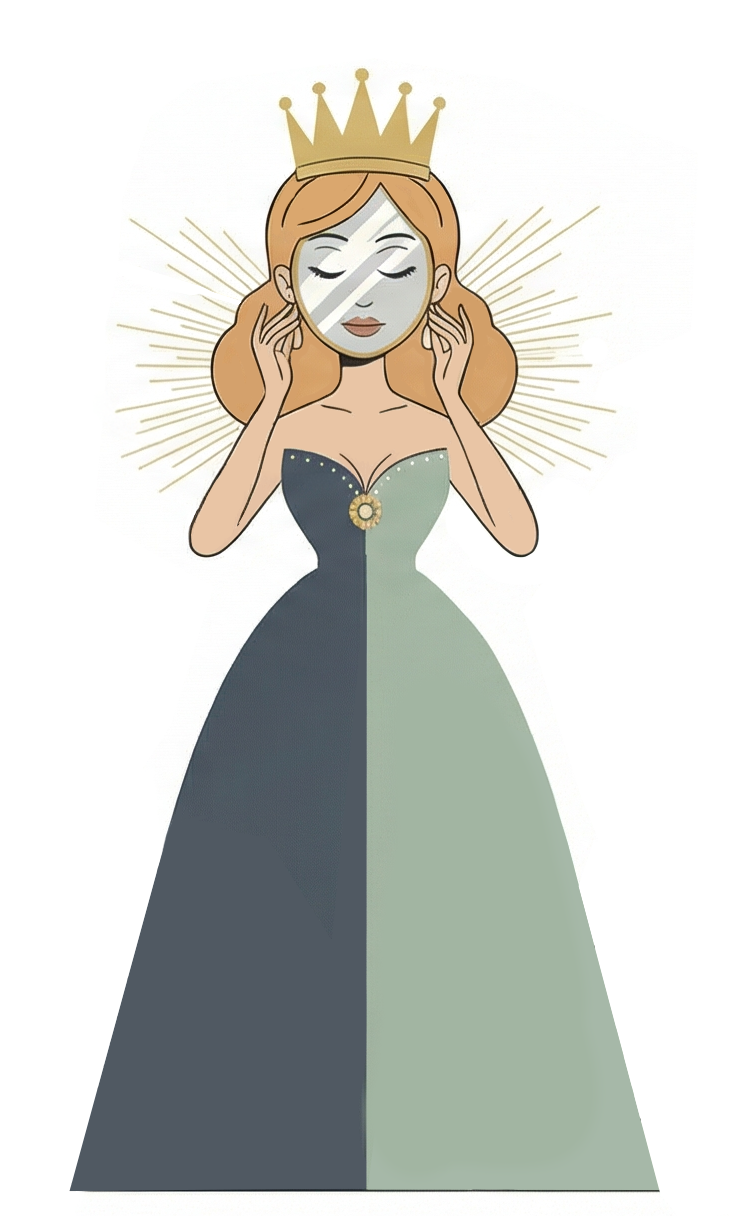
Also called vulnerable or hypersensitive narcissism, the type that hides in plain sight as fragility
Where the overt type performs confidence, the covert type performs woundedness. Vulnerable narcissism correlates with introversion, social insecurity, and a defensive, hypervigilant watchfulness for any sign of disrespect. She isn't loudly announcing her greatness. She's quietly certain the world keeps failing to recognize it, and she needs you to notice the injustice of that on her behalf.
Underneath, researchers find the two presentations share a common core: contempt for others, a fragile and heavily defended self-image, and very little real empathy. The difference is packaging. Grandiose narcissism reaches for admiration directly; vulnerable narcissism reaches for sympathy, obligation, and guilt, and tends to correlate with worse mental health outcomes and more indirect, low-risk forms of aggression, like exclusion, gossip, and the silent treatment.
She'll show up to help, genuinely, often, but rarely without strings. Praise, gratitude, and public credit are the price of the assistance, and withholding them turns the same act of "help" into fresh material for her next round of victimhood. Her up-and-down moods, warm one moment and cold or wounded the next, are frequently mistaken by family members for a mood disorder rather than a defense against imagined slights.
What she wants isn't a wide audience. It's a captive one. A spouse, a child, a tight family unit that can be relied on as a permanent, private source of the reassurance she can't get from people who see her clearly.
Psychologist George Simon's research on manipulative personalities names this pattern precisely: aggression obscured well enough to look like something else entirely
"I have no idea what you're talking about," delivered convincingly enough that you start doubting your own account of what just happened, forcing you to do the work of proving something that should never have needed proof.
Recasting herself as the injured party in a conflict she started, to gain sympathy and redirect blame, the emotional engine behind DARVO.
Performing selflessness and sacrifice loudly enough that questioning her motives looks ungrateful, which quietly obligates you to comply with what she wants next.
"It wasn't that big a deal" and a fast subject change, shrinking the conflict just enough that pursuing it further makes you look like the unreasonable one.
Suggesting, without quite saying it, that your boundary or your success has hurt her, after everything she's done for you, so that holding the line starts to feel like cruelty.
Quietly reframing the person who called out the behavior as the difficult one, the dramatic one, or the one with the real problem, often before that person even realizes a reputational campaign has started.
Confronting her produces sympathy, for her. Because the presentation is fragility rather than force, naming what's actually happening tends to read, to outsiders, as attacking someone weak and wounded. That reaction is exactly what protects her: it discourages the very people who see the pattern most clearly from saying anything at all, and it means the burden of proof falls disproportionately on the person doing the naming, not on her.
Further viewing on the covert (vulnerable) narcissist